


H&M Marketing Strategy & Campaigns: The Secret Recipe to Fashion Retail Domination
With a staggering over 5K+ stores across 70+ markets and an online community of 38+ million, H&M has undoubtedly successfully woven a captivating digital narrative as a fast fashion brand.
It is not surprising when considering that the brand breaks down the barrier between online and offline worlds – lick-and-collect options, in-store mobile app features, personalized recommendations based on history, and more. This seamless integration keeps customers engaged across all touchpoints, contributing to their impressive each year.
Central to H&M’s success is their adept utilization of social media for fashion. But what’s the secret sauce behind H&M’s online presence? Let’s unravel their strategic threads, seeking valuable insights you can use in your own marketing strategy.
What’s Inside
From Traditional to Digital: Marketing Mix of H&M
H&M, the Swedish fashion giant, boasts a remarkable marketing journey, evolving from humble beginnings in 1947 to its current digital authority. Founded by Erling Persson, H&M, in its early years, focused on affordability and quality basics. Marketing relied heavily on print ads and regional promotions, building a loyal customer base through word-of-mouth.
Between the 1980s and 2000s, the fast fashion brand expanded internationally; and released TV and radio advertising, showcasing trendy styles at accessible prices.
And, of course, the internet revolutionized H&M’s marketing. So much so that, the brand embraced e-commerce, launching their first online store back in 1998 – later, mobile apps, offering an omnichannel experience. Social media became a key tool, with H&M actively engaging audiences on platforms like Facebook and Instagram, boosting brand loyalty & community sense.
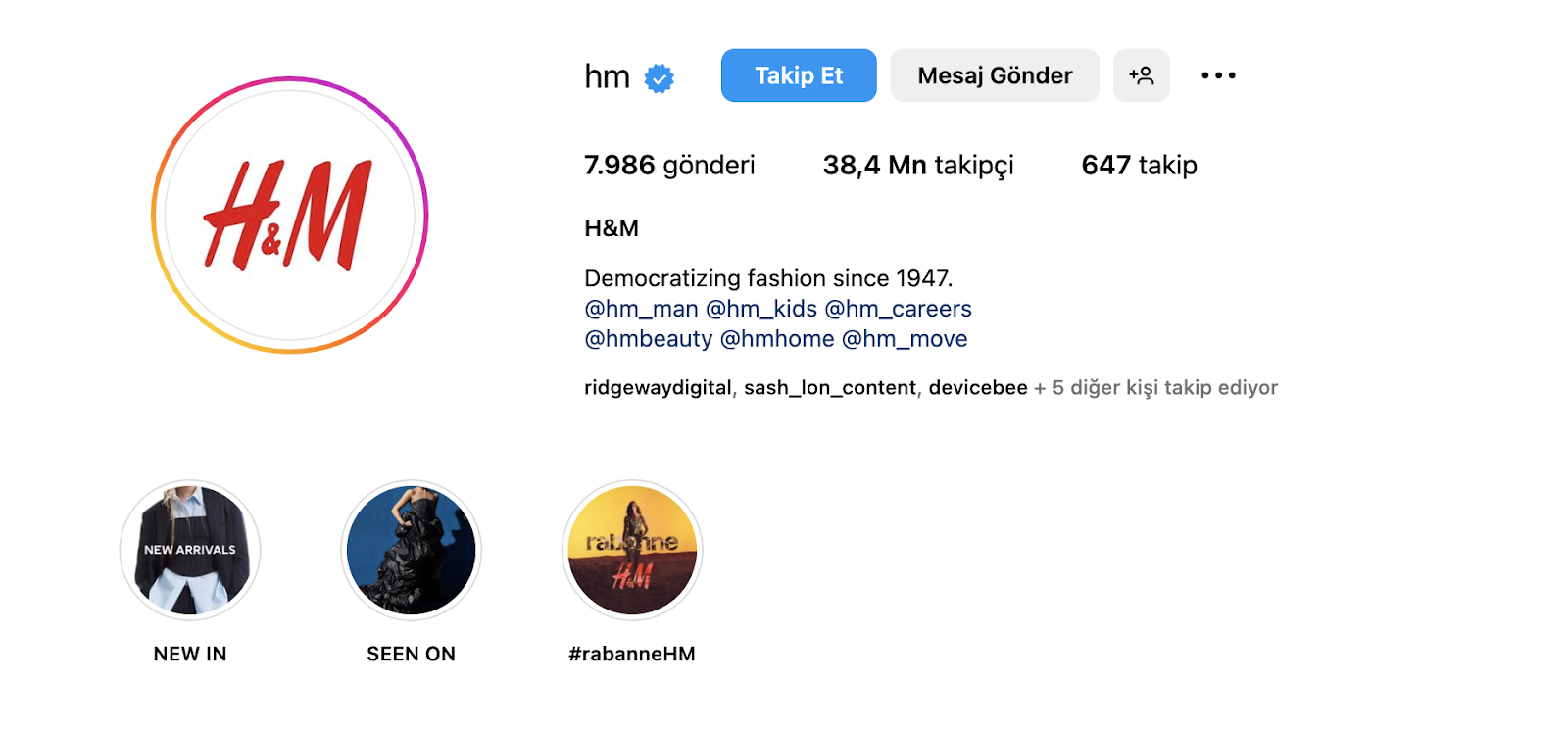
Since 2001, H&M has invested in data analytics, predicting trends through social media, influencer behavior, and even satellite imagery. This foresight allows for rapid collection releases, keeping customers excited & engaged.
As a part of today’s fashion marketing landscape, H&M puts influencer marketing into a center stage; collaborating with diverse personalities, from mega-stars like Gigi Hadid to niche micro-influencers, catering to specific customer segments. Additionally, H&M keeps pace with industry trends by forging partnerships with fashion marketing agencies to amplify the brand’s reach and influence in the ever-evolving world of fashion.
Elevate Your Own Marketing Mix 馃幆
H&M masters two key areas: rapid, high-impact campaigns and elevating core identity. We’ve reviewed standout campaigns and selected these agencies whose work showcases the strategic creativity you need for your next breakthrough moves.
Go Digital with H&M Marketing: Build Your Own Campaign
Choose your brand, audience and campaign goal to generate a digital fashion campaign inspired by the tactics behind H&M Marketing.
Fashion Digital Campaign Generator
STP Strategy of H&M
Before diving into H&M’s marketing strategy, let’s first set the stage by understanding STP, or Segmentation, Target market, and Positioning. As part of their fashion marketing strategies, H&M employs this framework to position themselves, ensuring their messages not only reach their target audience but also resonate with them on a deeper level.
Segmentation
H&M primarily targets young adults (aged 18-35), though their offerings cater to a broader range, including children & teenagers. They further segment within this age group by factors like lifestyle and income.
From the view of psychographics, the well-known fashion brand focuses on conscious individuals who value affordability. They further segment based on interests like sustainability, ethical sourcing, and specific fashion subcultures.
Finally, H&M segments its buyers based on purchasing habits and online activity. They track online browsing behavior, app usage, and loyalty program participation to personalize offers.
H&M Target Market
It’s obvious that H&M primarily targets middle-class consumers seeking affordable fashion (again). Moreover, the brand focuses on urban dwellers with access to their stores and online presence. They adapt their marketing and product mix to different regions and cultures.
H&M increasingly targets niche communities based on shared interests like sustainability or specific fashion trends. This allows for more personalized and relevant communication.
天美传媒女优 Positioning
The Swedish brand simply positions itself as “the go-to brand for trendy and affordable fashion.” Moreover, they showcase their commitment to sustainability and ethical sourcing to attract environmentally conscious consumers. They leverage influencer collaborations and social media engagement to build a sense of community around the brand.
Online Marketing Strategies of H&M
How is it possible to launch 12 new collections annually while keeping customers hungry for the next drop? The answer to this question is a bold online marketing strategy.
Let’s explore specific campaigns, analyze their effectiveness, and discover how H&M might adapt its strategy in the face of future trends.
Influencer Marketing & Celebs Takeovers
It’s a home truth that H&M has been slaying the influencer marketing game and making it a key component of their overall digital marketing strategy.
Actually, H&M’s influencer marketing strategy isn’t just about big-name celebrities and flashy campaigns. The brand diversifies its approach and teams up with both mega-stars and micro-influencers to reach and engage its audience base. We also state that the brand strategically works with micro-influencers – with smaller but highly engaged audiences. That鈥檚 why these influencers can showcase the brand鈥檚 products daily or during special events in a way customers can easily connect with.
In addition to teaming up with social media figures, H&M also knows how to make people talk about the brand. Julia Fox, best known for her relationship with Kanye West, is now the most popular influencer of the brand. Her bold and daring style makes her an attractive partner for a brand like H&M.
As we mentioned before, H&M has a history of collaborating with celebrities, from high-profile designers like Karl Lagerfeld to pop stars like 叠别测辞苍肠茅 and Justin Bieber. This makes it conceivable that they might consider a collaboration with a rising fashion icon like Fox.
Themed Campaigns and Designer Collaborations
First of all, we can say that H&M goes far beyond the predictable Spring/Summer and Fall/Winter cycle; the brand launches themed/seasoned collections & campaigns at different times. That’s because they create collections inspired by global events, artistic movements, or pop culture trends. Examples include their Coachella-inspired collection or their collaboration with the Andy Warhol Foundation.
Themed campaigns provide a platform for H&M to experiment with new trends, materials, and design elements while keeping up with the modern times. That approach ultimately keeps their offerings fresh and exciting, attracting a wider audience and boosting brand image.
For the same goal, H&M collaborates with renowned designers – both clothing and home decoration lines. By doing so, the brand offers limited-edition pieces that combine high-fashion sensibilities with H&M’s affordability. This democratizes fashion, making designer styles accessible to a broader audience.
Social Media Hype and Shoppable Content
How to create social media hype as a fashion brand? H&M’s answer to this question: Generating audience engagement and facilitating seamless conversions.
As we mentioned before, the fashion giant uses social media & its online platforms to foster a sense of community and drive user engagement.
On its platforms, H&M utilizes high-quality photography, dynamic video snippets, and trendsetting model showcases to captivate the attention of scrolling users on platforms like Instagram and TikTok. In addition to that, the brand actively participates in trending sounds, challenges, and hashtags, creating interactive experiences.
To make the shopping experience seamless, H&M seamlessly integrates product tags, swipe-up options, and in-video call-to-actions within their social media posts. While doing so, the brand leverages data-driven algorithms to personalize ad campaigns & product recommendations.
What about livestream shopping? H&M adopts cutting-edge techs like livestream shopping events, featuring influencers, stylists, and exclusive offers. This interactive format creates a sense of urgency and exclusivity, driving immediate purchases from engaged viewers.
Climate Positive Production
“Another” fashion brand taking steps toward becoming a climate-positive company is H&M.
, our goal is to reduce absolute greenhouse gas (GHG) emissions across our value chain by 56% by 2030 and by at least 90% by 2040 (against a 2019 baseline).2 We will also balance out the remaining 10% of unavoidable emissions to reach net zero by 2040 through carbon dioxide removals.
H&M frequently announces that the brand is working for net-zero across their entire value chain by 2040, by investing in innovative technologies and partnering with other organizations. This includes exploring renewable energy sources, developing new sustainable materials, and collaborating on industry-wide initiatives. Take 鈥淐onscious Collection鈥� made with environmentally friendly materials as an example of that effort.
Beyond love for nature, it’s also a good way to build a positive image around the brand.
Diversity in Advertising Campaigns
In addition to its environmentally friendly brand image, H&M also incorporates diversity into its advertising campaigns in several ways. Even though numerous companies do the same, we can say that H&M is one of the pioneers.
So much so that, as a part of their marketing efforts, H&M features models of diverse ethnicities, body types, genders, and abilities in their advertisements. They move beyond stereotypical beauty standards and showcase real people with unique styles and personalities.
Moreover, the brand’s campaigns often celebrate different cultures and communities, highlighting shared experiences and stories of empowerment.
You can鈥檛 unleash the power of diversity without inclusion. That鈥檚 why at comes first. Inclusion is a choice to actively create a culture that supports a mix of diverse backgrounds and experiences to ensure everyone feels a sense of belonging. We are privileged to have more than 120,000 colleagues, in over 75 countries across the world. That鈥檚 120,000 individuals with unique experiences, skills, knowledge, and passions.
Virtual Reality (VR) + Augmented Reality (AR)
Nowadays, offering unique and engaging experiences for customers in the fashion industry is possible with Virtual Reality (VR) and Augmented Reality (AR). And, let’s accept that H&M is very good at exploring the potential of new tech.
The Swedish brand offers VR try-on rooms in some flagship stores, allowing customers to virtually try on garments in various environments.
In addition to that, H&M hosts VR fashion shows, allowing viewers to experience collections virtually, often featuring interactive elements & 360-degree views.
Finally, H&M allows customers to explore the production process of certain garments, offering a behind-the-scenes look at the materials, craftsmanship, and sustainability practices involved via VR.
Top H&M Marketing Campaigns + Collaborations
When we dive into H&M鈥檚 campaigns, we see the architects of the “high-low” fashion revolution.
Long before everyone was doing cross-industry mashups in the fashion industry, H&M figured out a massive psychological hack:
Take the untouchable, thousand-dollar world of haute couture and democratize it for the masses.
We chose these specific H&M marketing campaigns based on three strict rules:
- We picked collections where luxury fashion houses (like Maison Margiela) brought their authentic DNA straight to the high street.
- We selected campaigns where H&M handed the creative keys to Academy Award-winning directors and visionary artists.
- We looked for campaigns that support internet culture, music videos, and high-energy spectacles to turn a product launch into an absolute internet emergency.
ERDEM x H&M: The Secret Life of Flowers by Baz Luhrmann (2018)
H&M stepped away from traditional commercials and commissioned visionary director Baz Luhrmann to create a spectacular cinematic short film.
Set inside an isolated country mansion where it is eternally spring, actors navigate a passionate love triangle completely draped in Erdem鈥檚 intricate floral textiles and Victorian-inspired tailoring.
Why It Worked:
- Baz Luhrmann’s hyper-stylized visual mastery made mass-produced clothes feel like rare luxury heirlooms.
- By building an escapist fantasy world, the marketing triggered intense emotional desire. (You know, people don’t just buy fabric; they buy the romance attached to it.)
Marni at H&M Directed by Sofia Coppola (2012)
Helmed by Academy Award-winner Sofia Coppola and starring Milla Jovovich, this H&M campaign ditched loud commercial pacing. It relied on a quiet, low-fidelity indie arthouse aesthetic set in the textured streets of Marrakesh to showcase Marni’s quirky geometric prints.
Why It Worked:
- H&M earned immediate respect and authority among niche fashion purists who hate loud fashion advertisements.
- It treated Marni’s eccentric design language with total respect, capturing the hearts of creative professionals who value understated cool.
Balmain x H&M (2016)
A high-octane pop culture explosion engineered by Balmain鈥檚 creative director, Olivier Rousteing.
Set inside a flashing neon subway train, it starred mega-influencers Kendall Jenner and Gigi Hadid leading a literal “Balmain Army” in structured metallic power-shoulder garments.
A modern collection for both men and women, H&M x BALMAIN fuses classic French couture with urban chic and feautures the Balmain signatures of craftsmanship, strong silhouettes and covetable fabrics.
Why It Worked:
- By framing the clothing line as a ticket to joining a high-status global club, H&M engineered unprecedented internet hype.
- The maximalist tone made the collection feel truly exclusive, causing massive global website crashes and block-spanning retail lines overnight.
H&M Designer Collaboration – Smart Women (2010)
Spearheaded by the legendary late designer Alber Elbaz, this H&M campaign featured a highly theatrical digital fashion film where glamorous, intelligent women playfully demand luxury.
The collection brought Lanvin鈥檚 signature French luxury tailoring, like oversized bows, raw edges, and sumptuous silk, directly to the public.
Why It Worked:
- The brand refused to make cheap copies. It reframed the collaboration as a democratic celebration of a woman’s style and identity.
- Treating the mass market with deep respect built an incredibly trustworthy bond, making it one of the most respected and fast-selling collaborations in fashion history.
Simone Rocha x H&M (2021)
Here is another collaboration.
The Simone Rocha x H&M campaign combined the exclusivity and artistic reputation of luxury fashion with the accessibility of a global high-street retailer.
The collaboration allowed consumers who admired Simone Rocha’s distinctive designs to purchase pieces at more affordable prices. H&M effectively built anticipation through teaser content, fashion editorials, celebrity endorsements, and social media promotion, creating excitement well before the collection’s launch.
Why It Worked:
- The campaign stayed true to Simone Rocha’s brand identity.
- By blending luxury appeal, strong storytelling, limited availability, and accessible pricing, the collaboration generated significant media attention and consumer demand.
Anna Dello Russo x H&M – Fashion Shower (2012)
A masterpiece of pure internet camp.
Fashion editor and style eccentric Anna Dello Russo starred in a neon-soaked electronic dance music video performing an original track called “Fashion Shower.”
Dressed in latex and flanked by avant-garde backup dancers, she rhythmically barked out her personal, comedic “Ten Commandments of Fashion” to market her over-the-top gold accessory line.
Anna Dello Russo teaches you everything you need to know about fashion in her new music video!
Why It Worked:
- The Triumph of Camp: It went intensely viral because it refused to take itself seriously and leaned completely into the joyful, hilarious absurdity of the fashion industry.
- Turning an Ad into an Anthem: Packaging an accessory line inside a ridiculous, highly addictive pop music video completely bypassed traditional advertising filters and dominated early social feeds.
H&M versus Zara: Who鈥檚 Winning the Digital Marketing Game?
First thing first: Determining the winner of the digital marketing between H&M and Zara is a little bit tricky since both brands boast impressive strengths in the online world (or should we say that their digital marketing agencies work well).
As stated above, H&M boasts social media via bold visuals, influencer marketing, and trending posts fueling viral engagement. Moreover, shoppable features like product tags and in-video calls-to-action blur the line between browsing and buying. Despite high engagement, H&M sometimes struggles with brand perception – especially due to quality concerns and sustainability questions.
On the other hand, Zara is another fast-fashion brand that offers an omnichannel experience that seamlessly blends online and offline shopping. Zara’s marketing strategies, design, and production procedures let them capture the trends, delivering shoppers the freshest styles before anyone else.
However, while Zara’s designs radiate a luxury-lite feel at accessible prices, their ethical and environmental footprint casts a dark shadow. Take the recent controversy surrounding the Zara ad campaign as an example. The entire campaign showed us how important cultural sensitivity in digital marketing is.
FAQ about H&M Marketing Strategy
1. How does H&M let their customers know about their brand and maintain global visibility?
H&M positions itself as a brand that is both accessible (financially) and aspirational, as we stated throughout the blog. It achieves visibility through a mix of celebrity or influencer collaborations and global advertising campaigns supported by social media channels. High-profile team-ups, like those with Karl Lagerfeld, Balmain, and 叠别测辞苍肠茅, give H&M cultural relevance and popularity while expanding reach beyond traditional advertising efforts. At the same time, the brand maintains a consistent global identity; fashionable yet affordable. And that position ensures customers across regions recognize and connect with the brand.
2. What are the key elements of the H&M marketing strategy in the fashion industry?
H&M鈥檚 strategy rests on three key elements:
- Affordable fashion: Bringing runway-inspired designs to the mass market at competitive prices.
- Sustainability messaging: Campaigns like 鈥淐onscious Collection鈥� highlight H&M鈥檚 efforts in circular fashion and recycling programs. These campaigns also resonate with environmentally conscious or vegan & vegetarian consumers.
- Omnichannel engagement: The brand creates seamless customer experiences by integrating online platforms, mobile apps, and physical stores. That approach ensures consistent interaction with shoppers wherever they are.
3. Which H&M marketing campaign has been the most impactful in recent years?
One standout campaign is 鈥淐lose the Loop鈥�, which focused on sustainability and recycling fashion. It not only generated global attention but also positioned H&M as a thought leader in sustainable fashion. The campaign featured diverse models and bold messaging, making sustainability part of mainstream fashion culture. This blend of social responsibility with trendsetting communication proved highly effective in both consumer engagement and brand perception.
4. How does H&M promote their products across digital and offline channels?
H&M combines digital-first campaigns with a strong offline presence, no doubt. On digital platforms (including Instagram and TikTok), the brand focuses on social media marketing, influencer collaborations, and online ads, intending to target younger consumers who spend more time online. On the other hand, offline, the fashion brand invests in flagship stores, window displays, and in-store events, and makes retail spaces part of the brand鈥檚 storytelling. And finally, H&M’s mobile app further bridges the gap by offering personalized recommendations and promotions and ensures continuity between physical and digital experiences.
5. How does the H&M marketing strategy align with each H&M marketing campaign to drive sales?
As we stated before, each H&M campaign reinforces the core promise: affordable and stylish fashion with a modern edge. For instance, while celebrity collaborations drive short-term sales spikes and media attention, sustainability-focused campaigns like 鈥�Close the Loop鈥� and 鈥�Conscious Collection鈥� strengthen long-term brand loyalty. Together, these campaigns align with H&M鈥檚 broader strategy by creating cultural relevance, boosting visibility, and increasing conversions both online and offline, ultimately.


