


McDonald’s Marketing Strategy & Campaigns: Why It’s Still the King of Fast Food
Whether you’re grabbing breakfast in Tokyo or a late-night meal in Paris, McDonald’s feels instantly familiar. McDonald’s marketing strategy is built on consistency, emotional relevance, and the ability to feel local in every market.
Familiarity carries through in its marketing by showing how different generations, cultures, and communities connect through a shared, yet locally adapted McDonald’s experience.
It’s global, but it still feels personal.
In this post, I’ll break down how McDonald’s achieves that, step by step.
If you are in a rush, please use the links below to jump to the section you need.
Inside McDonald’s Marketing Campaigns
- McDonald’s Marketing Mix (But in 7Ps)
- Who Actually Is McDonald’s Target Audience?
- McDonald’s ÌìÃÀ´«Ã½Å®ÓÅ Positioning
- McDonald’s ÌìÃÀ´«Ã½Å®ÓÅ Loyalty
- McDonald’s Social Media Strategy (Powered by Memes and MilkShakes)
- McDonald’s versus Burger King Marketing Strategy
- McDonald’s Advertising: Culture-Driven, Visual, and Adaptable
- What to Remember from McDonald’s Marketing Campaigns
- Frequently Asked Questions About McDonald’s Marketing Strategy
If you are ready to dig in, let’s start from the very beginning.
Back in , brothers Richard and Maurice McDonald opened the first McDonald’s restaurant in San Bernardino, California. In 1948, they revolutionized the business with the introduction of the “Speedee Service System,� setting the template for modern fast food.

As of 2026, McDonald’s operates over across more than 100 countries. Systemwide sales, which include total sales across all company-operated and franchised restaurants, surpassed for the year.
However, McDonald’s didn’t achieve rapid growth and its current position through hard work alone, but also by implementing its well-built marketing strategies for fast food restaurants.
When the company was searching for new ways to catch the attention of customers in the 1970s, they launched the Happy Meal, one of their most outstanding achievements.
This led to the world’s first Happy Meal, a combination of meals suitable for children, including a free toy.
After that, McDonald’s momentum never really slowed. Franchising took off, the Drive-Thru made fast food even faster, and menu icons like the Big Mac and McMuffin turned into global staples. With each decade, the brand found new ways to connect—rolling out ²Ñ³¦°ä²¹´Úé, embracing digital orders, and constantly refreshing the menu to fit local tastes.
McDonald’s Kept Evolving—What’s Yours?
We’ve reviewed countless case studies and handpicked two agencies that truly stand out in food marketing. Each brings creativity, strategy, and flavor to brands that know how to connect with hungry audiences, like McDonald’s does.
How can you serve billions of customers each year?
McDonald’s marketing strategy focuses on appealing to a wide range of customers, from young children to families, and even to health-conscious consumers (with their catchy slogans, such as “I’m Lovin’ It� and “Have It Your Way.“)
The magic of McDonald’s is in the details. It makes global feel familiar, and local feel special, no matter where you order.
McDonald’s offers local menu staples, McAloo Tikki in India and SamuraiMac in Japan:
Localization of the brand and the products is a key move in McDonald’s marketing; local offerings only generate 30% of the overall sales, while the remaining 70% is driven by its core global classics.
Localization goes beyond just the menu. McDonald’s adapts its restaurant designs to reflect local lifestyles—French locations, for example, are known for their chic, café-inspired interiors (as seen in Emily in Paris).
Let’s break down its every aspect from marketing mix and branding to social media and ads.
McDonald’s Marketing Mix (But in 7Ps)
McDonald’s marketing mix shows how a global brand can scale while staying agile and locally relevant. In this section, we’ll reference an article by , a lecturer at Manchester Metropolitan University, titled “McDonald’s: ‘Think Global, Act Local’ – The Marketing Mix.�
1.Product: Streamlined Offerings with Cultural Sensitivity
Rather than offering a one-size-fits-all menu, McDonald’s adapts its product lineup to fit cultural and regional preferences. As the article notes, in India, McDonald’s removed beef, mutton, and pork items from its menu—an adaptation made to align with religious and cultural values.
This strategic localization reflects the company’s broader philosophy: global branding with regional flexibility.
By limiting the product range on purpose, McDonald’s not only simplifies operations but also enhances its alignment with local tastes, helping the brand remain relevant across diverse markets.
2.Price: Adaptive Value Strategies
McDonald’s focus on pricing reflects the market’s economic environment. Rather than applying a fixed global pricing model, McDonald’s adjusts prices according to local conditions—an approach that positions the brand as both affordable and accessible.
The decision to limit the menu also supports pricing efficiency, reducing overhead while maintaining profitability. This cost-control mechanism allows McDonald’s to offer value without compromising quality, particularly in markets where price sensitivity is high.
3.Place: Proximity as a Power Move
McDonald’s location strategy relies on a franchising model that allows rapid expansion while maintaining brand consistency. New restaurants are placed based on data—foot traffic, surrounding businesses, population density, and accessibility all play a role in determining where to grow next.
Typical locations include:
- Urban centers
- Transit hubs
- Busy shopping districts
Each site is chosen to align with customer routines. The goal is simple: be where people already spend time, and make stopping by easy. Local franchisees bring regional knowledge to the table, helping the brand adapt to community habits while upholding global standards.
This approach keeps McDonald’s highly visible, easy to reach, and deeply embedded in daily life.
4.Promotion: Blending Tangibility with Emotion
McDonald’s success in promotion is rooted in its ability to deliver both tangible elements (such as consistent packaging and product presentation) and intangible elements (like emotional connection and familiarity). These combine to form a brand experience that feels consistent globally but still resonates on a local level.
McDonald’s integrates localization into its promotional strategy—adapting messaging, visuals, and even in-store design to fit regional consumer behavior and preferences. This approach supports its “think global, act local� mantra.
5.People: Service Standardization with Local Understanding
At the heart of McDonald’s operations is a consistent service culture upheld by strict staff training and performance guidelines.
Regardless of location, customers can expect the same level of friendliness, cleanliness, and efficiency. Employees are trained to embody the brand’s core values, ensuring a uniform customer experience worldwide.
At the same time, staffing is localized. Hiring from the local population allows each restaurant to better connect with community expectations, cultural norms, and service styles. This balance between global standards and local familiarity helps build trust and repeat visits in diverse markets.
6.Process: Streamlined Operations that Scale
McDonald’s operational model is engineered for speed, simplicity, and consistency.
Processes are tightly structured, from food preparation to delivery, ordering systems to in-store workflow, making it easy to replicate success across thousands of outlets.
The result is a reliable customer experience, whether in a bustling urban drive-thru or a suburban dine-in.
These standardized systems:
- Reduce wait times
- Enhance staff productivity
- Reinforce the brand promise
7.Physical Evidence: ÌìÃÀ´«Ã½Å®ÓÅed Consistency Across Touchpoints
Every detail of the McDonald’s environment is designed to reinforce its identity and create a familiar, reliable experience. Key elements include:
- Architecture: Consistent exterior design with signature elements like the Golden Arches
- Interior layout: Functional, standardized restaurant flow for dine-in and takeaway
- Staff uniforms: ÌìÃÀ´«Ã½Å®ÓÅed attire that reflects cleanliness, professionalism, and brand identity
Menu boards: Clear, visually unified digital or printed displays across locations - Packaging: Iconic wrappers, cups, and bags that are both functional and recognizable
Dining area cleanliness: Maintained to meet global hygiene standards - Signage clarity: Easy-to-read visuals that guide customers efficiently
- Navigation ease: Intuitive layout that supports a seamless customer journey
Who Actually Is McDonald’s Target Audience?
McDonald’s target audience is intentionally broad, covering a wide range of demographics and lifestyles. From children and families to students, professionals, and late-night customers, the brand is designed to be accessible to all income levels and age groups.
McDonald’s target market strategy focuses on being familiar, inclusive, and emotionally resonant. It builds its messaging around themes like nostalgia, convenience, and shared experiences, rather than targeting one narrow segment.
The in the FAQ section of McDonald’s official website testifies to what I said above:
McDonald’s aims to offer a friendly, fun environment for everyone, and we mean everyone, to enjoy. This means appealing to families who love our iconic Happy Meal®, to workers grabbing breakfast on-the-go or eating in to enjoy our freshly ground coffee and free WiFi.
By operating a variety of third-party data sources – demographic, psychographic, and behavioral data – to create audience segments that are relevant to its products & services. For instance, McDonald’s might target its ads for “Happy Meals” to families with young children or “Create Your Taste” to millennials while targeting health-conscious consumers with its menu options, such as salads and smoothies.
At that point, it is possible to say that data clicked to age, gender, location, income, household size, education level, values, lifestyle, app usage, and social media activity act as a source for the fast food chain to target its advertising and marketing campaigns in addition to personalizing its customer experience (CX).
Before closing that chapter, I would also like to mention a surprising fact about the typical McDonald’s customer. According to a highly prestigious source, Business Insider, the average customer of the brand is strikingly – here are the details:
The typical McDonald’s customer is a married white woman between the ages of 41 and 56, according to data provided by analytics firm Numerator. She likely lives in a suburban area in the southeastern US, and her household makes more than $80,000 a year. This typical shopper either has an undergraduate degree or attended some college.

After all these efforts… How satisfied the customers of McDonald’s are?
Before releasing the figures, I’d like to remind you what the American Customer Satisfaction Index is. In the most basic terms, ACSI is a benchmark that tracks customer satisfaction across various industries in the US. ACSI scores range from 0 to 100, with higher scores indicating greater customer satisfaction. While the ACSI score doesn’t provide a specific satisfaction percentage, a score above 70 is generally considered good.
According to a recent survey released by Statistica, McDonald’s ACSI score for US restaurants in 2023 was , and this figure falls within the “neutral” satisfaction range, according to the ACSI website.
Additionally, the 2021-dated found that:
- 38.49% of respondents were satisfied with the food at McDonald’s.
- 23.68% were neutral.
- 33.22% disliked the burgers (though satisfaction with other menu items might be higher).
While not a negative score, it suggests there’s room for improvement in customer satisfaction for McDonald’s.
McDonald’s ÌìÃÀ´«Ã½Å®ÓÅ Positioning
ÌìÃÀ´«Ã½Å®ÓÅ awareness Oscar goes to McDonald’s, for sure.
McDonald’s has successfully marketed itself for decades based on core values of convenience, affordability, and fun.
The restaurant is well-known for providing fast and tasty food at an affordable price, making it a popular destination for families and friends worldwide. The brand’s emphasis on creating a welcoming atmosphere and maintaining high standards has contributed to its widespread recognition.
In addition to offering play areas for kids and convenient takeout options, McDonald’s has also made impressive strides in the digital space, achieving impressive feats. Its digital marketing strategy is constantly evolving to keep up with the latest trends & technologies.
Another great example that reminds customers of their childhood:
The company is always looking for new ways to reach and engage its target audience online, by using a variety of online channels and tactics including SEM, SEO strategies, social media marketing, email marketing, and mobile marketing.
McDonald’s ÌìÃÀ´«Ã½Å®ÓÅ Loyalty
McDonald’s isn’t just selling fries and burgers; they’re selling an emotional connection. In other words, the fast-food giant really understands that brand loyalty goes beyond just delicious fries and burgers. That’s why they’ve cultivated a following by creating a multi-faceted approach that fosters a strong connection with their customers.
When it comes to building brand loyalty, the cornerstone is McDonald’s rewarding programs. Through basic apps like The My McDonald’s Rewards program, the brand allows customers to earn points with purchases and redeem them for free food.
Similarly, their online stores like Golden Arches Unlimited are giving customers a way to express their love for the brand and creating a permanent place for them to engage with McDonald’s beyond just grabbing a meal.
This is actually a clever (and basic) loyalty program strategy; from both the sides of the customer and the brand itself. By offering unique branded merchandise, McDonald’s taps into fans’ desire to celebrate their affinity with the brand. This isn’t new – McDonald’s has been partnering with fashion brands for merchandise since the 1980s, and many loyal customers likely remember the McDelivery Collection.
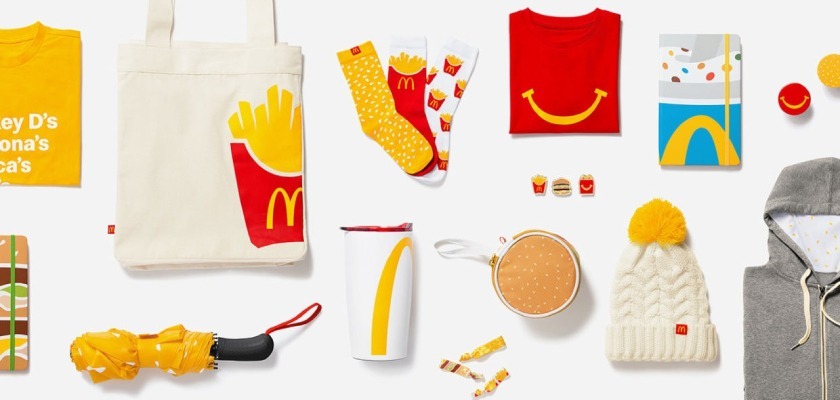
What’s more, Colin Mitchell, Senior VP of the brand’s Global Marketing commented in a statement:
McDonald’s has been ingrained in the fabric of culture for years, and there’s a long history of fans wearing our brand with pride. We’re excited to help customers wear their brand love on their sleeves with the unveiling of Golden Arches Unlimited as we continue to inspire feel-good moments with McDonald’s.
McDonald’s Social Media Strategy (Powered by Memes and MilkShakes)
The fast food giant has a bold online presence on all major social media platforms, which can be considered the core element of McDonald’s digital marketing strategy.
McDonald’s social media strategies are rooted in a blend of cultural relevance, brand consistency, and everyday engagement, showing just how vital creative food marketing agencies can be.
From platform-specific content and playful memes to nostalgia, pop culture moments, and user-generated campaigns,
McDonald’s meets people where they are, without ever losing its brand voice, with the help of
- 🕰� Nostalgia
- 🌟 Pop culture moments
- 🤳 User-generated content (UGC)
- 😂 Memes
- 📲 Platform-specific content
McDonald’s French Fries Wayfinding Campaign
The fact: McDonald’s uses unique artistry in each aspect of its digital marketing – creative visuals, storytelling, humor, and interactivity to connect with its target group on a deeper level.
As a great example of that approach, 4 years ago the brand teamed up with TBWA/Paris and allowed its iconic French fries to show the way.
These digital ads are inspired by minimalism, the emblematic artistic movement of the 21st century. According to the directions, 8 pop-colored posters are proposed to make 64 different combinations. The campaign was art directed by Emile Chiumino and Camille Roulant. With that campaign, while most brands put their regular logo and an arrow as a direction for their customers, McDonald’s has taken a more novel approach.
TBWA/Paris X McDonald’s collaboration continues with similar works:
Why That Campaign Worked
This campaign worked because it turned one of McDonald’s most recognizable products into a visual navigation tool. Instead of relying on heavy messaging, the brand used something people already instantly associate with McDonald’s: its fries. The simplicity made the idea powerful. It was clever, easy to understand, and highly shareable because it connected product recognition with real-world utility.
Cardi B & Offset Meal
Yes, teaming up with celebrities is a common and effective way for any kind of brand to reach a wider audience and build excitement for their products or services; but, McDonald’s makes it in a better way.
In 2021, McDonald’s partnered with Cardi B to create a custom meal called the Cardi B & Offset Meal. Since that date, the well-known couple has promoted the menu on various channels.
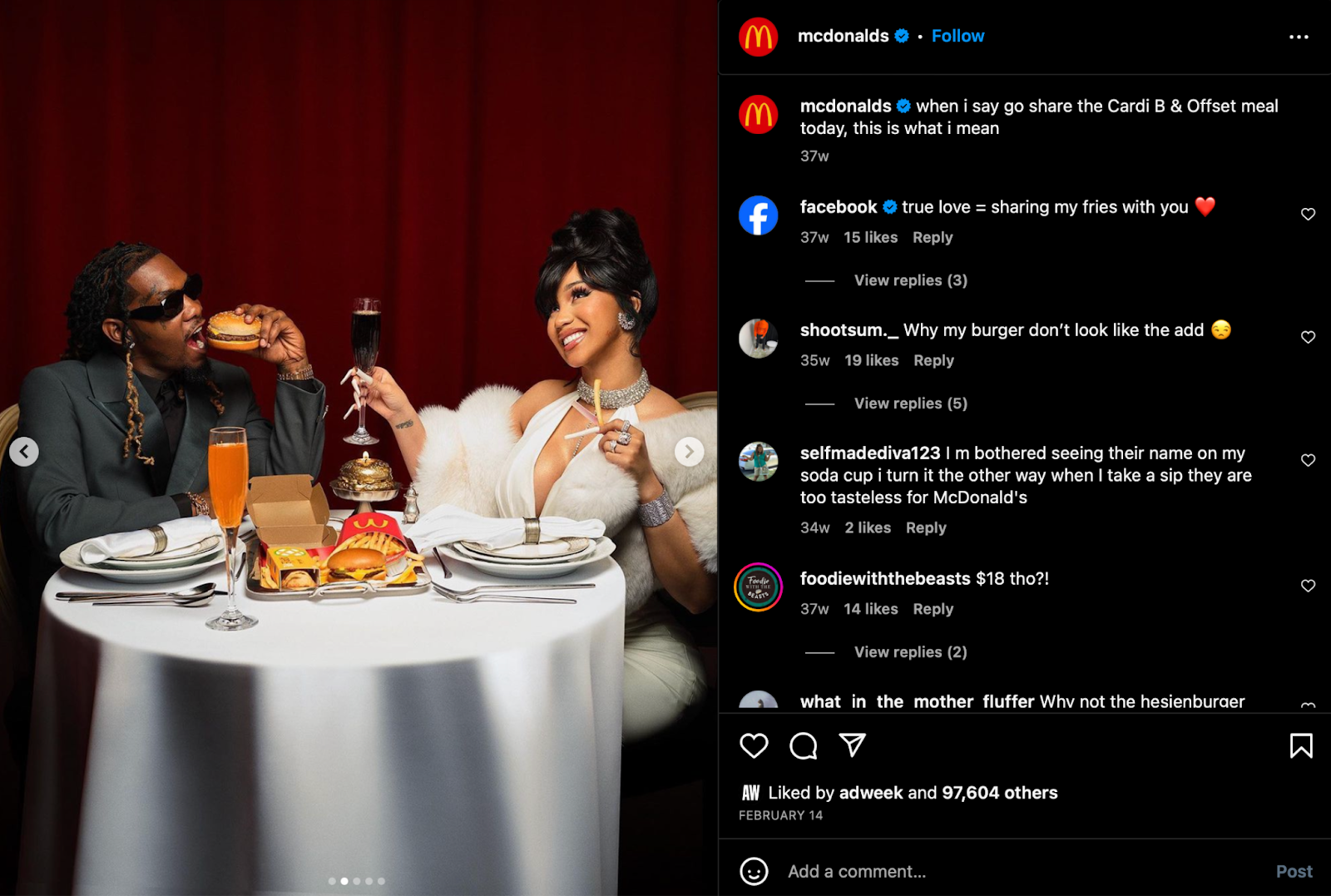
For instance, the following TikTok video hit 24M views and over 3M likes.
Why That Campaign Worked
The Cardi B & Offset Meal worked because it combined celebrity culture, fan behavior, and everyday ordering habits in a way that felt natural. Instead of simply putting famous faces in an ad, McDonald’s turned their actual order into something fans could try for themselves. That made the campaign feel more personal and participatory.
Saweetie Meal
In the same manner, the company partnered with famous R&B singer Swatee to create a custom meal called the Swatee Meal. In addition to promoting the special menu items, Swatee also takes McDonald’s social media accounts for the video series Swatee Meal Class:
Why That Campaign Worked
The Saweetie Meal worked because it understood how younger audiences interact with food online. Saweetie’s brand is playful, stylish, and highly social, which made her a natural fit for a campaign built around customization and self-expression.
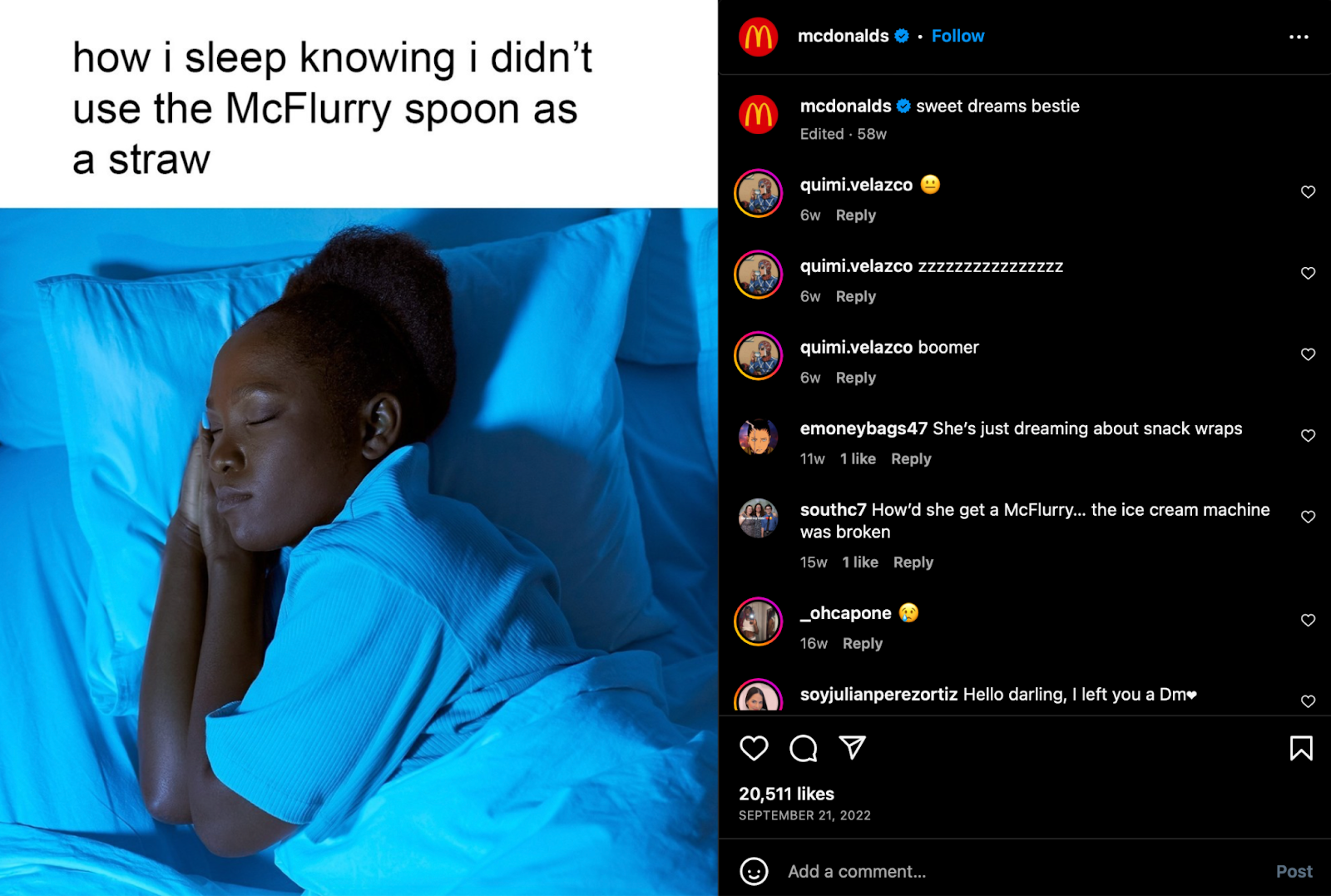
No need to say but… McDonald’s always uses humor and storytelling in its restaurant marketing campaigns.
From meme marketing to happy TikTok videos; from video series about a group of friends who love to eat at the restaurant to online competitions, the brand constantly shares funny and relatable content to create a positive association among followers.
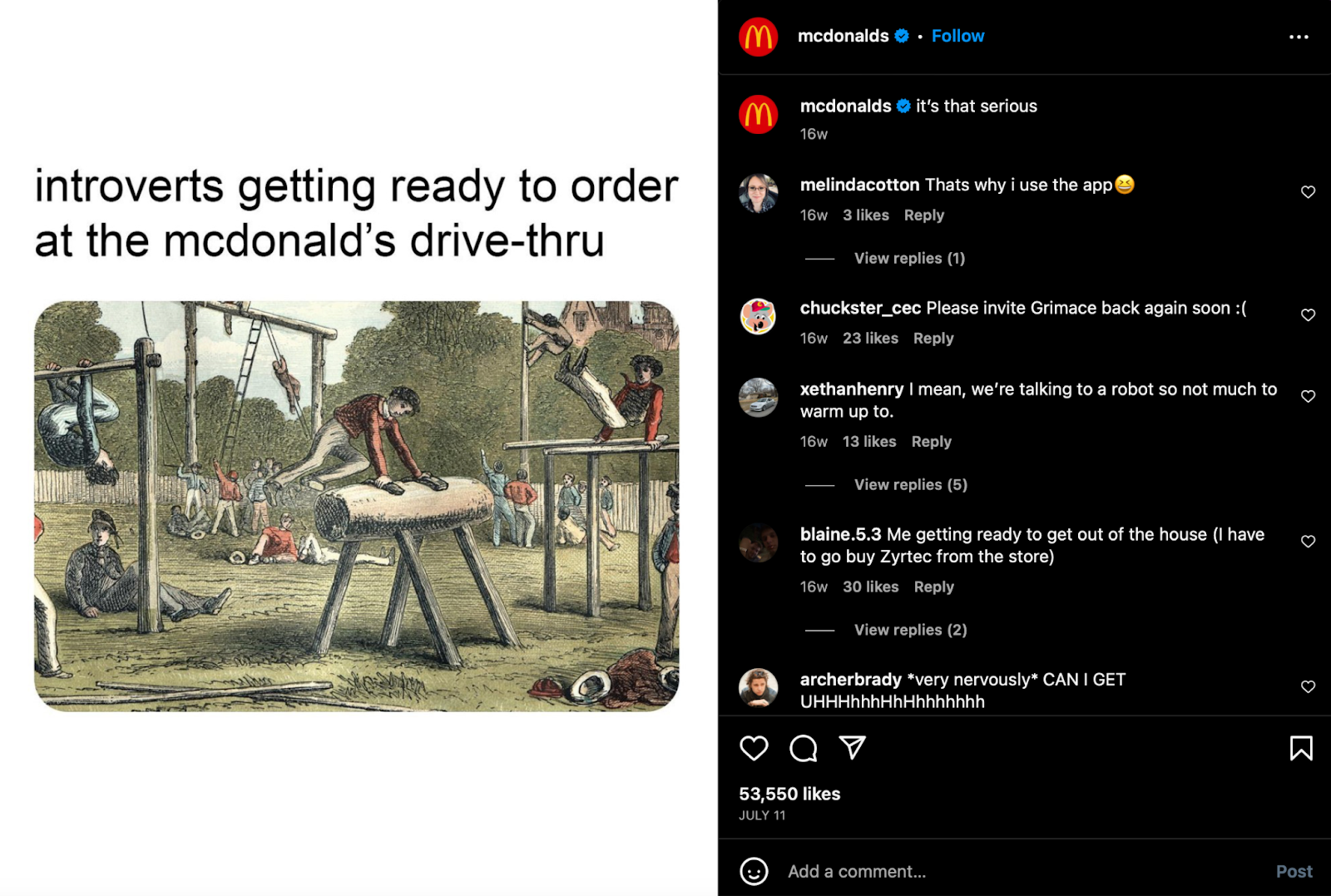
Another one?
Wrap Battle
As an example of that approach, recently, the company started a competition called “Wrap Battle� in TikTok, showing the entertaining moments of employees:
Why That Campaign Worked: Wrap Battle
Wrap Battle worked because it gave the audience something to react to, not just something to watch. By turning a menu item into a playful competition, McDonald’s created a format that encouraged opinions, comments, and participation.
The McD Challenge
Similarly, back in 2022, the marketing team launched a digital marketing campaign called “The McD Challenge.” The campaign challenged customers to create & share their unique meals on social media.
The campaign was a success, generating over 100 million views and over 1 million pieces of content.
Why That Campaign Worked
The McD Challenge worked because it made McDonald’s part of user-generated entertainment. Instead of asking audiences to passively consume a campaign, it invited them to create their own version of it.
Wednesday Dance Challenge
Let’s accept that we remember times when we see McDonald’s and its signature menus everywhere; in series, films, magazines, and even sports events.
The brand, which has a long history of using mass culture references, has focused its digital marketing efforts on creating creative comebacks from pop culture. And, yes, this strategy has been very successful for the company, especially in generating buzz online.
In 2023, the food chain started a “Wednesday� dance challenge on TikTok. The ad featured a group of McDonald’s employees doing the dance challenge. The ad was a fun and engaging way to connect with the target audience while raising brand awareness one more time.
Why That Campaign Worked
The Wednesday Dance Challenge worked because it connected McDonald’s to an existing cultural moment. The campaign did not try to force attention from scratch; it joined a trend people were already watching, copying, and sharing.
That timing made the campaign feel relevant. By tapping into a viral dance format, McDonald’s reached audiences in a way that felt native to TikTok and short-form video culture. It showed how the brand can move quickly, adapt to pop culture, and participate in conversations without sounding overly corporate.
Create Your Taste
The company also uses pop culture references to promote its latest menu items. When launching its new “Create Your Taste� menu in 2023, the company released an ad that referenced the popular TV show “Chopped� and used the catchphrase “It’s all up to you.�
After that, a great number of people run into the restaurant to make their unique menus, like “making the biggest burger possible� – and have shared their experience with create your taste kiosks.
Why That Campaign Worked
Create Your Taste worked because it gave customers control. Instead of promoting one standard menu item, McDonald’s invited people to build something that matched their own preferences. That sense of choice made the experience feel more premium and personal.
McDonald’s versus Burger King Marketing Strategy
Both McDonald’s and Burger King serve burgers and fries, but when it comes to marketing, they live in entirely different worlds.
One leans on legacy, consistency, and emotional warmth.
And the other’s focus is on bold moves, big stunts, and playful punches—even at its biggest rival.
I’m Lovin’ It
McDonald’s is the world’s comfort zone. It doesn’t shout; it doesn’t shock. Instead, it shows up—reliably and familiarly. Its “I’m Lovin’ It� campaign has been going strong for over two decades, evolving subtly to stay culturally relevant while keeping its tone positive and universal.
Why That Campaign Worked
I’m Lovin’ It worked because it was simple, emotional, and flexible. The phrase was short enough to remember, broad enough to work across markets, and positive enough to connect with everyday moments.
Its biggest strength was that it did not focus only on food. It focused on feeling. Whether someone was grabbing fries after school, getting coffee on the way to work, or sharing a meal with friends, the slogan could fit into almost any situation. That emotional flexibility helped it become one of McDonald’s most enduring brand assets.
Famous Orders
Take the “Famous Orders� campaign. Rather than creating something new, McDonald’s tapped into everyday fan behavior—asking, what do celebrities order when they go to McDonald’s?
The answers came in the form of special meal bundles featuring Kim Kardashian, Kanye West, Dracula, The Invisible Man, and more!
It was smart, subtle, and wildly successful without breaking character.
Why that McDonald’s Campaign Worked
Famous Orders worked because it revealed a simple human truth: even celebrities have a McDonald’s order. That made the brand feel universal. By showing that well-known figures order from the same menu as everyone else, McDonald’s turned familiarity into excitement.
Then there’s Burger King’s marketing strategy. The brand loves to stir the pot, and its tone is cheeky, unfiltered, and often aimed straight at McDonald’s.
The “Whopper Detour� campaign, for instance, offered users a Whopper for 1¢—but only if they ordered it while standing near a McDonald’s. Pure mischief, powered by clever geo-targeting.
McDonald’s keeps its menu tight and tuned to local tastes. From to , the chain proves it knows when to globalize and when to localize. Seasonal items like the or the return of the keep things exciting without shaking the foundation.

Image source:
Burger King takes the opposite approach, loud and proud about its flame-grilled offerings. It constantly puts the Whopper front and center, often calling it the superior burger.
When It Comes to Digital, It’s Brains vs. Bravado
McDonald’s plays the long game in digital. Its app integrates ordering, rewards, and delivery in one clean ecosystem. The is a perfect example of value-driven loyalty, using personalization and convenience to keep customers coming back.
Burger King, meanwhile, treats digital as a playground. In the “Stevenage Challenge,� it sponsored a tiny football club just to get its logo into FIFA games. Fans were rewarded for scoring goals with Burger King-branded players—and they did, in droves. I believe that it was genius.
So, I can say that McDonald’s wins hearts through consistency, comfort, and emotional resonance. Burger King wins attention by challenging the norm, embracing chaos, and roasting the competition. Both approaches work, but they’re playing very different games.
McDonald’s Advertising: Culture-Driven, Visual, and Adaptable
McDonald’s keeps its advertising sharp by focusing on cultural timing and clear, visual ideas.
Instead of relying on heavy messaging, the brand often builds campaigns around familiar products and public figures, making the experience feel relatable rather than promotional.
One example featured celebrity meal combinations tied to artists like Kanye West and famous figures like Dracuşa. The strategy didn’t involve launching new items. Instead, it gave existing ones renewed relevance through pop culture alignment. And the simplicity of the campaign made it easy to understand and easy to share.
Visual storytelling is another strength.
As marketer highlighted in a recent LinkedIn breakdown, a McDonald’s ad showing phones styled like fries works because it “lands in under two seconds.�

No headline, no slogan—just a clear visual metaphor that speaks on its own:
- Emotional visuals over functional messaging
- Sharp concept instead of layered complexity
- Well-timed placement rooted in cultural context
McDonald’s also allows room for audience participation. In 2023, the Grimace Shake became a viral trend through user-generated TikTok content.
Rather than steering away from the unexpected tone, the brand embraced it, which kept the product in the spotlight far longer than a traditional rollout might have.
Advertising is adjusted by region as well. During the 2024 Paris Olympics, a campaign in France highlighted the brand’s around the world, turning small cultural details into a message of global unity.
McDonald’s – Welcome as You Are
For the 2024 Paris Olympics period, McDonald’s France and DDB Paris shifted the idea from simply inviting people in to actively welcoming visitors from around the world. The campaign celebrated the many nicknames people use for McDonald’s globally, including McDo, Mickey D’s, Maccas, Mequi, Makudo, Mecces, and Makka.
The campaign was built around a strong global-local tension. On one side, McDonald’s is one of the most recognizable global brands in the world. On the other, people experience it in very local ways: through nicknames, habits, menu preferences, and everyday routines. “Welcome as You Are� uses that tension beautifully by saying: wherever you come from, and whatever you call us, you are still welcome here.
Why that Campaign Worked
Welcome as You Are worked because it focused on inclusivity without making the message feel forced. The campaign positioned McDonald’s as a place where different people, moods, lifestyles, and moments are all welcome.
That idea fits naturally with the brand’s role in everyday life. McDonald’s is not positioned as exclusive or distant; it is familiar, accessible, and open to everyone. By building the campaign around acceptance and comfort, the brand strengthened its emotional connection with customers while staying true to its mass-market identity.
Bonus: How Much Does McDonald’s Spend on Ads?
Although it may seem like the answer to the question is “hundreds of millions of dollars,� the reality is a bit more complex.
The global fast-food giant, McDonald’s, splits its advertising costs into two main categories: advertising cooperatives and production costs for television and radio. According to figures released by Statista, back in 2022, McDonald’s spent on advertising cooperatives and on the production of radio and TV commercials.

The same year, marketers may remember, the Wall Street Journal announced that McDonald’s was making a significant investment in its marketing strategy by .
Its advertising spending will increase to 10% from 4% between 2021 and 2024 to platforms owned by groups including Black, Hispanic and Asian Pacific American people, women and LGBT people. For Black-owned properties, spending will rise to 5% from 2%.
This move, of course, highlights a clear focus on expanding their media reach and potentially signals a shift in how they target consumers. So, there is no exact figure for McDonald’s current advertising budget is elusive, the news of doubling their budget suggests a significant increase, potentially reaching well over $700 million based on past figures.
What to Remember from McDonald’s Marketing Campaigns
A box of fries that looks like phone icons.
A celebrity meal that feels like a shared secret.
A jingle that hasn’t changed in decades, but still hits.
McDonald’s focuses on refinement—on making familiar things feel current, again and again.
Here’s what to take away:
- Culture over noise. McDonald’s doesn’t shout—it shows up in your feed, in your neighborhood, in your language.
- Familiar > flashy. You already know the menu. But it still feels fresh, because they make it feel like yours.
- Tech that fits. Whether it’s mobile ordering or AI-driven personalization, innovation is there, but never in your face.
- Localization at its finest. It’s a global giant, but somehow, it still feels like the corner spot.
- Visuals that land. No words needed—just fries shaped like phones, and your brain fills in the rest.
Frequently Asked Questions About McDonald’s Marketing Strategy
What marketing strategies does McDonald’s use?
McDonald’s marketing is built around a simple idea: be consistent, feel local, and stay emotionally relevant. The brand leans on its global 7Ps framework while adapting to each market with local menus, cultural references, and community-driven campaigns. Whether it’s a Happy Meal or a pop-up moment with a celebrity, every move is designed to feel familiar and intentional.
What does McDonald’s digital marketing strategy consist of?
McDonald’s digital game is strong because it knows how to blend storytelling with utility. From app-based loyalty programs to trend-savvy TikToks, the brand uses humor, nostalgia, and real-time engagement to keep its voice fresh. Its content isn’t just promotional — it’s made to be part of how people already communicate online.
How does McDonald’s promote their products?
Promotion at McDonald’s is more about moments than messages. Sometimes it’s a minimalist billboard that doubles as wayfinding. Other times, it’s a limited-edition meal built around pop culture. The brand uses simple visuals, recognizable cues, and sharp timing — all grounded in the idea that the familiar can still surprise you.
How does McDonald’s use social media?
McDonald’s doesn’t treat social media like a checklist — it uses each platform in its own voice. TikTok becomes a space for user challenges and celebrity takeovers, while Instagram leans into bold visuals and nostalgic throwbacks. Campaigns are built to be shared, not just seen, and that’s what keeps the brand part of the conversation.
Who is McDonald’s target audience?
The short answer: almost everyone. But McDonald’s doesn’t speak to the crowd in one voice. It creates tailored messages based on data — age, habits, location, lifestyle. A parent might see a Happy Meal ad. A student might scroll past a meme about fries at midnight. The goal is always the same: meet people where they are, in a way that feels personal.
🫵 Got thoughts on McDonald’s marketing?
Share this on LinkedIn and tag us—or me! I’d love to chat.
And, if you are hungry for more brand analysis and real marketing insights, you should check out the other marketing strategy deep dives of famous brands below.


